
Why Asbestos Abatement Solutions Matter for Every Building Owner
Asbestos abatement solutions are the professionally managed methods used to safely identify, contain, remove, or encapsulate asbestos-containing materials (ACMs) in buildings — protecting occupants from serious, life-threatening disease.
Here are the main asbestos abatement solutions used today:
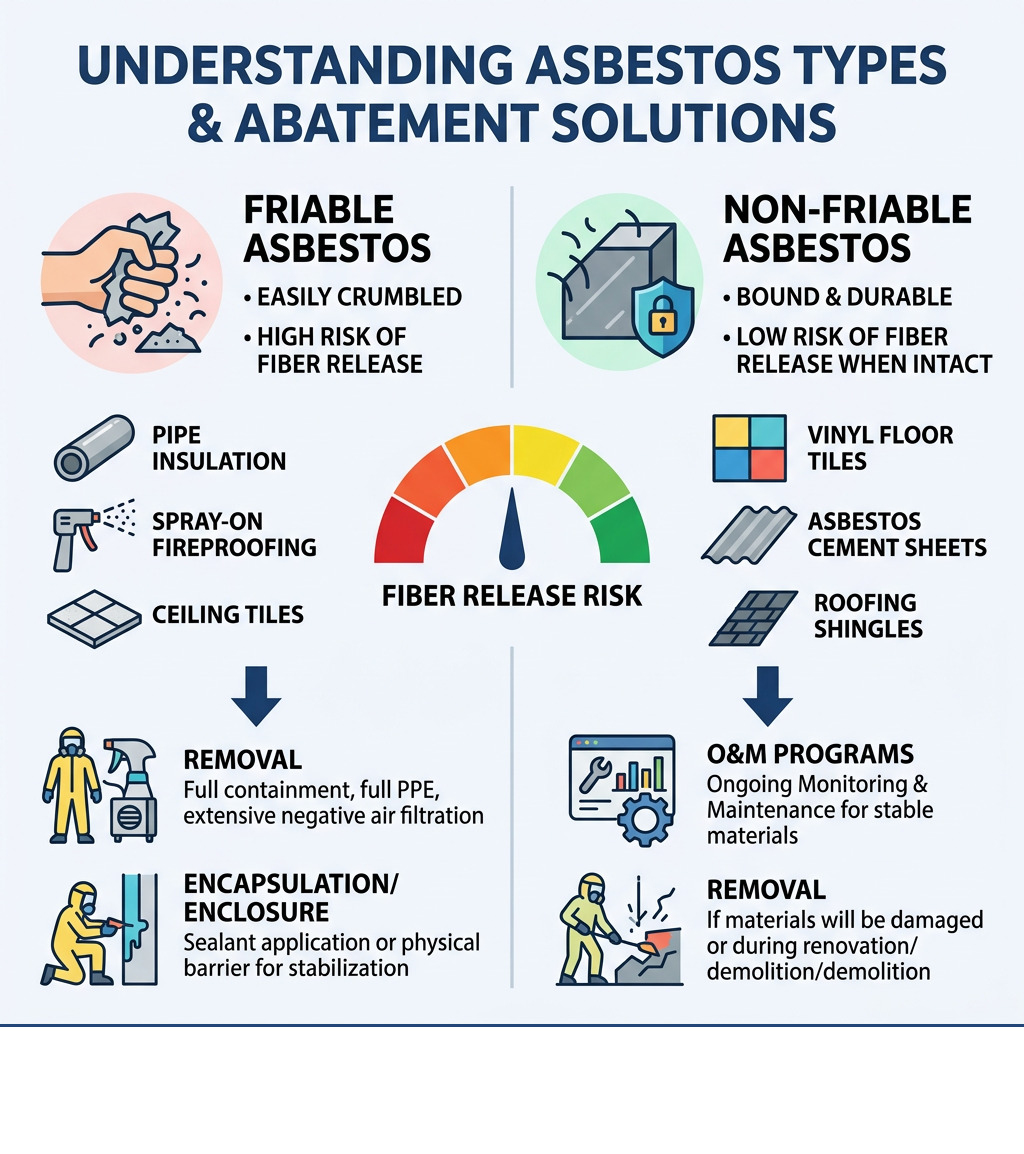
Removal: asbestos-containing materials are fully taken out and disposed of through regulated procedures. Best for renovation, demolition, or materials that are damaged and likely to release fibers.
Encapsulation: a specialized coating is applied to asbestos-containing materials to lock fibers in place and reduce the chance of release. Best for intact materials in areas with low disturbance.
Enclosure: a durable barrier is built around the asbestos-containing material so it remains separated from occupied space. Best for larger areas or situations where long-term management makes more sense than removal.
Operations and Maintenance (O&M): asbestos is left in place, but managed through routine inspection, monitoring, and clear work practices to prevent disturbance. Best for stable materials in occupied buildings.
Asbestos is a group of naturally occurring fibrous minerals. For most of the 20th century, it was added to more than 3,000 building materials because of its strength, heat resistance, and durability. That made it incredibly common — and incredibly dangerous.
When asbestos fibers become airborne and are inhaled, they can cause severe, irreversible lung diseases. These include asbestosis (scarring of the lungs), lung cancer, and mesothelioma — a rare but aggressive cancer linked exclusively to asbestos exposure. Symptoms often don’t appear until 10 to 35 years after exposure, which means many people don’t realize the damage until it’s too late.
Around 2 million tons of asbestos is still used globally every year, and older buildings across New England remain a significant source of exposure risk.
Knowing your options — and acting on them quickly — can make all the difference for your building, your tenants, and your legal standing.
I’m Stephen Wenzel, Co-Owner and Executive Vice President of Banner Environmental Services, with more than 25 years of hands-on experience in asbestos inspections, abatement planning, and regulatory compliance across Massachusetts, Rhode Island, and the greater New England region. Throughout my career, I’ve guided residential, commercial, and industrial property owners through every type of asbestos abatement solution — from emergency response to large-scale pre-demolition projects. In this guide, I’ll walk you through what actually works, so you can make an informed decision with confidence.
Understanding Professional Asbestos Abatement Solutions
When we talk about “abatement,” we are talking about an umbrella term. Many people use “asbestos removal” and “asbestos abatement” interchangeably, but they aren’t exactly the same thing. Removal is just one type of abatement. Professional Asbestos Abatement involves a comprehensive plan to mitigate the risk of asbestos fibers entering the air.
Abatement vs. Removal
Think of abatement as the “strategy” and removal as the “action.” If you have a pipe wrapped in asbestos insulation that is falling apart (friable), removal is likely the only safe option. However, if the material is in good condition, we might suggest other asbestos abatement solutions that are less invasive.
Encapsulation Methods
Encapsulation involves treating the asbestos-containing material with a sealant. This sealant either penetrates the material to bind the fibers together or creates a tough “skin” over the surface. It’s a great solution for materials like asbestos-containing pipe insulation that is still structurally sound. It’s often faster and more cost-effective than full removal, provided the material won’t be disturbed by future renovations.
Enclosure Strategies
Enclosure involves building a permanent, airtight barrier around the asbestos. For example, if you have asbestos floor tiles, we might install a new subfloor and new flooring directly over them. This “traps” the asbestos so it can’t be nicked or scuffed, which would otherwise release fibers.
To help you decide which path is right for your property, check out this comparison of Asbestos Removal: Right & Wrong.
Removal
- Most permanent option
- Usually the highest-cost approach
- Carries the most risk during work, so full containment is critical
- Eliminates future liability because the asbestos is no longer on-site
Encapsulation
- Can be temporary or long-term depending on the material and condition
- Often a lower-cost option
- Lower risk during the work than removal
- Leaves asbestos in place, so future liability remains
Enclosure
- Typically a long-term management strategy
- Often falls in the moderate range compared with other methods
- Lower risk during the work than removal
- Leaves asbestos in place behind a barrier, so future liability remains
Identifying Asbestos-Containing Materials in Your Property
You can’t always tell if a material contains asbestos just by looking at it, but history gives us some very strong clues. In New England, specifically in places like Boston, MA, and Providence, RI, our historic building stock is full of Asbestos-Containing Materials.
Common Locations
Asbestos was the “miracle mineral” used in everything from the basement to the roof. Common spots include:
- Floor Tiles and Mastic: Those classic 9×9 inch tiles are almost always a red flag.
- Pipe Insulation: Often looks like corrugated paper or “blankets” wrapped around steam pipes.
- Roofing and Siding: Asbestos-cement shingles were incredibly popular for their fire resistance.
- Drywall Joint Compound: Even the “mud” used to smooth out walls often contained fibers until the late 1970s.
Specialized Risks: Vermiculite and Insulation
One of the trickiest materials we deal with is vermiculite attic insulation. Much of the vermiculite sold in the U.S. under the brand name “Zonolite” came from a mine in Libby, Montana, that had a natural deposit of asbestos. If you see pebble-like, pour-in insulation in your attic that looks shiny or metallic, you likely need Vermiculite Asbestos Abatement. Knowing How to Tell if Insulation is Asbestos is the first step in keeping your family safe.
For residents in our southern service areas, the Asbestos | Rhode Island Department of Environmental Management provides excellent local resources on what to look for in older New England homes.
The Step-by-Step Process of Effective Remediation
Effective asbestos abatement solutions aren’t just about “tearing things out.” It is a highly regulated, scientific process designed to ensure that the air inside your building is cleaner when we leave than when we arrived.
Initial Testing and Asbestos Abatement Survey
Before a single piece of tape is laid down, we must know exactly what we are dealing with. An Asbestos Abatement Survey is the foundation of a safe project. What is an Asbestos Survey? It’s a thorough inspection where a licensed professional takes bulk samples of suspicious materials. These samples are sent to accredited laboratories for polarized light microscopy (PLM) testing. You can learn more about the specifics of Asbestos Testing on our dedicated service page.
Containment and Execution of Asbestos Abatement Solutions
Once we have a positive test result, the real work begins. We follow a strict protocol:
- Regulated Area Setup: We seal off the work zone using heavy-duty polyethylene sheeting and duct tape.
- Negative Pressure: We use high-capacity HEPA-filtered air units (often 700–2000 CFM) to create negative pressure. This ensures that if there were a leak in our plastic, air would blow into the work area, not out into your home.
- Controlled Wetting: We never “dry scrape” asbestos. We use amended water (water with a wetting agent) to keep fibers heavy and wet so they can’t float away.
- PPE: Our team wears specialized suits and respirators that are fit-tested annually.
- Final Air Clearance: After the materials are gone and the area is cleaned, a third-party lab conducts air clearance testing to prove the space is safe for re-occupancy.
For a deeper dive into the mechanics, read Professional Asbestos Removal: How It Works. This is especially critical for Commercial Asbestos Abatement, where business continuity and employee safety are the top priorities.
Regulatory Compliance and Choosing a Contractor
In environmental remediation, “cutting corners” isn’t just bad business—it’s illegal and dangerous. Asbestos projects are governed by a web of federal and state agencies, including OSHA (worker safety), the EPA (environmental protection), and NESHAP (air quality during renovation/demolition).
Licensing and Certifications
In New England, every state has its own specific rules. For example, if you’re in Portland or Bangor, you should consult the list of Licensed Asbestos Abatement Contractors – Maine.gov. At Banner Environmental Services, we maintain all necessary licenses across MA, RI, NH, CT, VT, and ME. We are also WBE and DCAMM certified, which speaks to our commitment to high-level professional standards.
Insurance and Coordination
A major part of our job is reducing client stress. This often involves working directly with your insurance company to handle claims. We provide the comprehensive reports and documentation they need to see that the job was done according to code.
Historical Disposal Sites and Property Maintenance
In certain parts of New Hampshire, like Nashua and Hudson, there are over 300 identified “asbestos disposal sites” where manufacturing waste was used as fill decades ago. If you own property in these areas, maintenance is key. This includes regular site inspections and ensuring that “capping” materials (like soil and vegetation) remain intact to prevent fibers from surfacing. Always keep detailed disclosure records; if you sell a property with known asbestos, transparency is your best legal defense.
Frequently Asked Questions about Asbestos Remediation
How much do asbestos abatement solutions cost?
While we don’t provide flat pricing (because every job is unique), several factors influence the final investment. The type of material is a big one—removing friable pipe insulation is more complex than removing non-friable floor tile. Accessibility also matters; an open warehouse is easier to clear than a cramped crawlspace. Finally, the square footage and the specific disposal fees at EPA-certified landfills will play a role. You can find more details on the Asbestos Removal process and its variables on our site.
What are the long-term benefits of professional removal?
The most immediate benefit is health and safety. You can’t put a price on knowing your family or employees aren’t breathing in carcinogens. Beyond that, professional Asbestos Removal increases property value. Many buyers will walk away from a deal if they find asbestos; having a “clean” certificate of abatement makes your property much more marketable. It also reduces your long-term liability and ensures you are in full regulatory compliance.
How is asbestos waste safely discarded?
You can’t just throw asbestos in the trash. Professional Asbestos Disposal requires double-bagging in 6-mil poly bags that are leak-tight and properly labeled. We then use DOT-compliant transport to move the waste to EPA-certified landfills specifically designed to handle hazardous materials. For more on this critical final step, see our page on Asbestos Disposal.
Conclusion
Dealing with asbestos can feel overwhelming, but it doesn’t have to be. Whether you are a homeowner in Worcester, MA, a facility manager in Providence, RI, or a developer in Nashua, NH, the key is to act decisively and professionally.
At Banner Environmental Services, we bring over 25 years of New England-specific expertise to every project. Our team is fully licensed, WBE/DCAMM certified, and dedicated to meeting and exceeding every OSHA and EPA requirement. We don’t just remove hazards; we provide peace of mind.
If you suspect your property has asbestos, don’t wait for a “lucky break.” Contact us today to discuss the best Asbestos Abatement Solutions for your specific needs. From the initial survey to the final air clearance, we are with you every step of the way.